
Piezo Fast Steering Mirrors for Optical Inter-Satellite Links
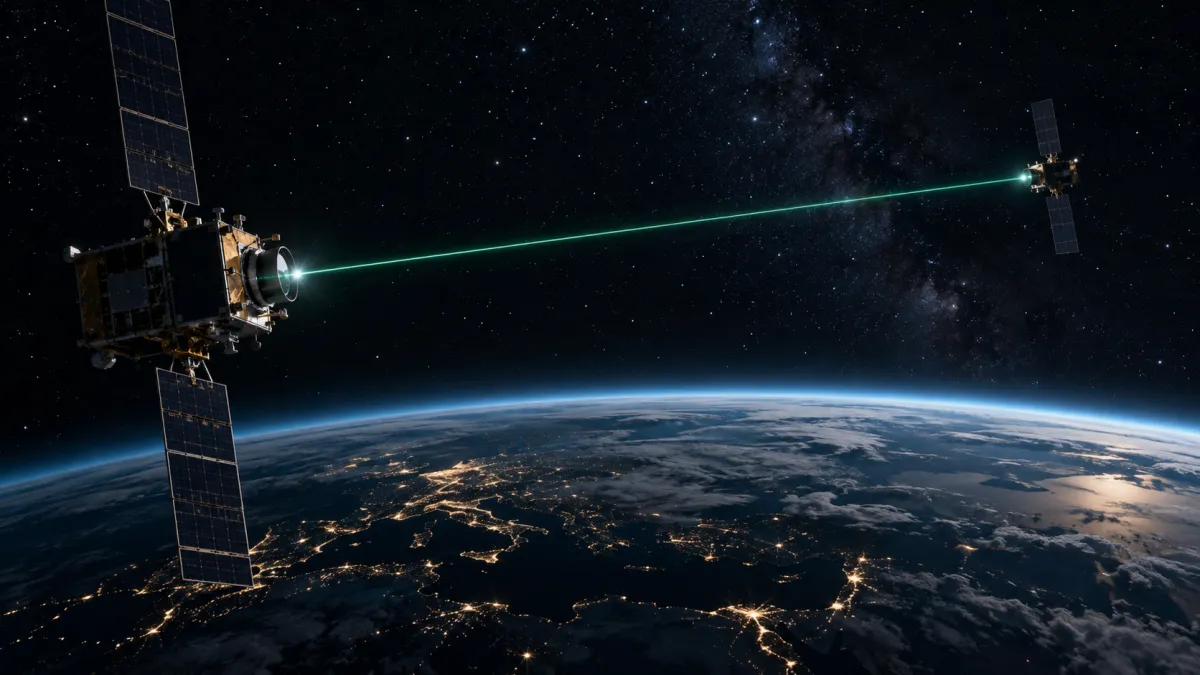
In modern Optical Inter-Satellite Links (O-ISL) , stable, high-speed communication between satellites is enabled by laser technology. This application demands motion systems with ultimate precision and dynamic response to maintain a flawless laser link across vast distances—a requirement perfectly met by piezosystem jena’s technology.
Our systems are critical for:
- Active Vibration Damping: Counteracting platform disturbances and vehicle vibrations that could cause beam jitters.
- Fine Steering and Alignment: Continuously correcting the beam path to compensate for minor misalignments.
- High-Speed Adjustment: Ensuring rapid compensation to maintain link quality at gigabit speeds.
Piezo Solutions for Aerospace Data Communication Applications
In general, piezo based FSMs are ideal for use in space environments due to a number of inherent technology benefits. Piezo solutions offer:
- Instantaneous Response Times
- No Electromagnetic Interference
- Low Power Consumption
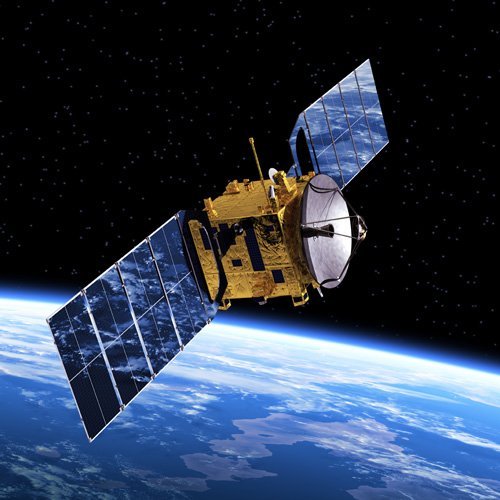
Satellites with fast steering tip-tilt mirrors for directing laser communications are being designed now for launch over the next few years.
Over the past ten years, piezosystem jena has developed an extensive product line of FSMs. Our FSMs are designed to provide the following benefits for use as Fine Steering Mirrors and Point Ahead Mirrors in optical terminals:
- High Displacements – for faster pointing, acquisition, and tracking.
- High Stiffness – to increase the achievable bandwidth with large mirrors.
- Smart Flex-Hinge Designs – for friction and stiction free operation without mechanical wear, thus improving reliability.
- Small Form Factors – to allow for easier terminal integration and cheaper payload launch costs.
Our FSMs:
- Displacements up to ±20 mrad.
- Sub-microradian resolutions.
- Closed-loop strain gauge feedback for elimination of hysteresis and drift.
- Bandwidths up to 6500 Hz.
Space Qualified – Developed by European Space Agency
Why Our Technology Was Tested for Space
Despite preliminary suitability, the systems still lacked the rigorous proof of suitability for all space applications required for flight. The space qualification test by ESA was necessary to design and validate a system capable of handling the dual, complex requirements of O-ISL and possessing superior robustness to withstand shock and vibration loads during launch over a wide temperature range.
How We Passed the Test
Our latest series of PSH series ( PSH 20/2 and PSH 35/2 ) were initially developed for European Space Agency (ESA) as the SQATTS (Space Qualified Tilting System) project. The technology phase was successfully completed, providing proof of the targeted specifications based on the engineering models that were set up, and confirming system readiness.
This validation confirmed our systems for the critical, dual functions of:
- Fine Steering Mirrors (FSM): Compensating for external disturbances and atmospheric aberrations in real-time.
- Point-Ahead Mechanisms (PAM): Creating a precise offset angle between the transmitted and received laser beams to account for the satellite’s movement during the light’s time of flight.
Our PSH design provides one solution for both FSM and PAM applications, resulting in a significant reduction in integration effort and costs for optical systems.
Key Features of our Space Qualified PSH Series
Our space-qualified PSH 20/2 and PSH 35/2 design offers major advantages for O-ISL applications:
- Unrivaled Precision: As solid-state devices, piezo actuators offer virtually unlimited positioning resolution and zero mechanical play, which guarantee the highest pointing accuracy.
- Robust and Reliable: The systems feature high robustness to withstand the extreme shock and vibration loads during launch, a wide operating temperature range, and an outstanding lifetime.
- Energy Efficient: Due to their capacitive nature, our piezo actuators consume no electrical power while holding a position, making them ideal for power-constrained satellite platforms.
This project together with ESA confirms that our PSH systems meet the most stringent criteria for space qualification, making them the superior choice for not only O-ISL but also other critical lab and production environments, such as those found in advanced semiconductor manufacturing tools.
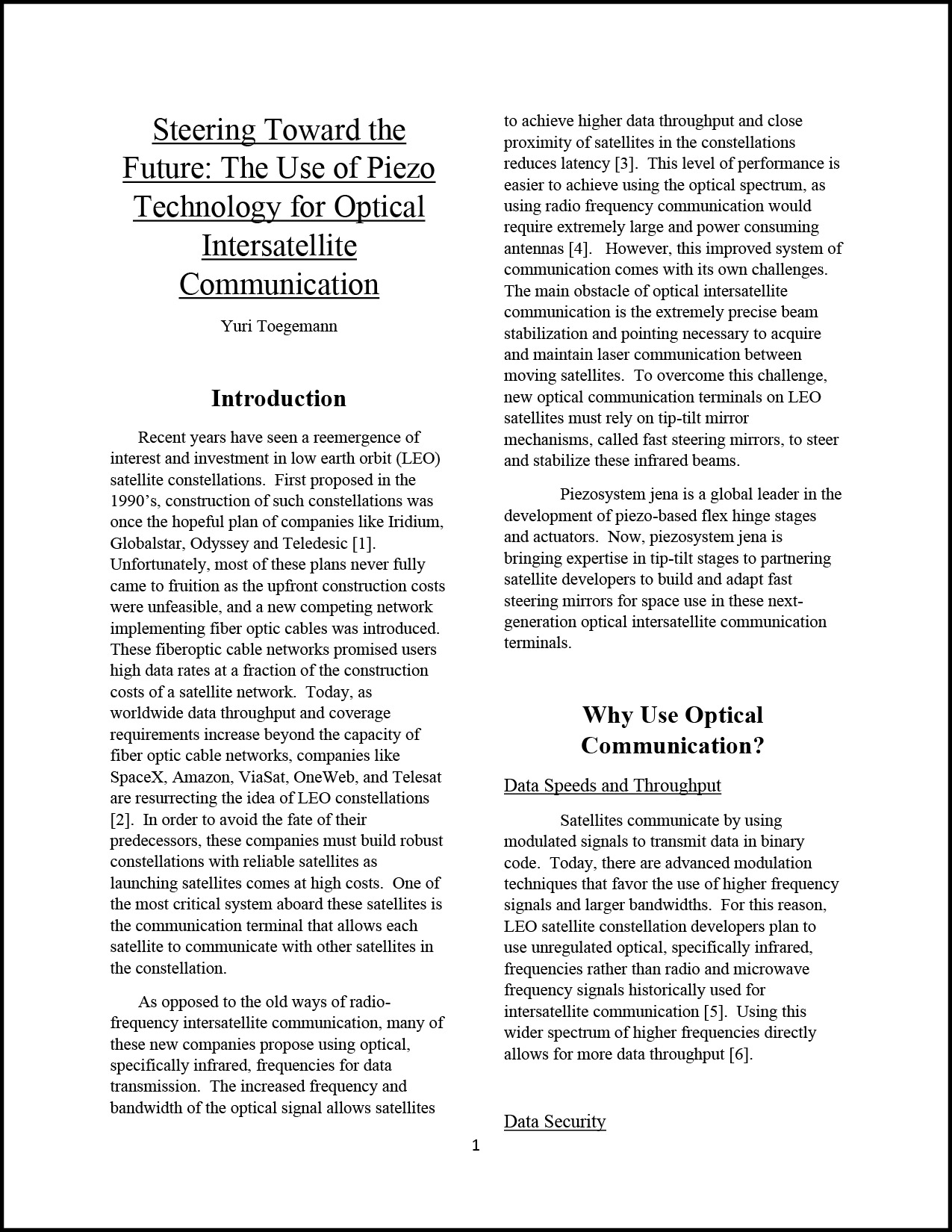
Read the ‘Steering Toward the Future: The Use of Piezo Technology for Optical Intersatellite Communication’ Whitepaper.
Click here to download
FAQ
衛星光通訊用的快速轉向鏡,偏轉角與頻寬是多少?
偏轉角度最高可達 ±20 mrad、次微弧度解析度、頻寬最高 6,500 Hz,並以閉迴路應變規回授消除遲滯與漂移。這組規格對應光學終端裡的精細指向鏡與前置指向鏡用途。
為什麼太空應用偏好壓電式 FSM?
壓電致動器是固態元件,提供近乎無限的定位解析度與零機械間隙;撓性鉸鏈無摩擦、無黏滯、不會機械磨耗;而且因為電容特性,保持位置時不消耗電力,對功耗受限的衛星平台很關鍵。此外還有瞬時響應、無電磁干擾、低功耗等先天優勢。
精細指向鏡(FSM)和前置指向機構(PAM)要各配一套嗎?
不必。PSH 設計以單一方案同時滿足 FSM 與 PAM 兩種應用,大幅降低光學系統的整合工作量與成本。PSH 20/2 與 PSH 35/2 最初就是為歐洲太空總署的 SQATTS 專案開發,技術開發階段已成功完成、工程模型驗證了目標規格。